The Invisible Runner
Tracking study · 2024/25 A-LeagueWhat changes when a player runs without the ball?
Loading the reviewed match…
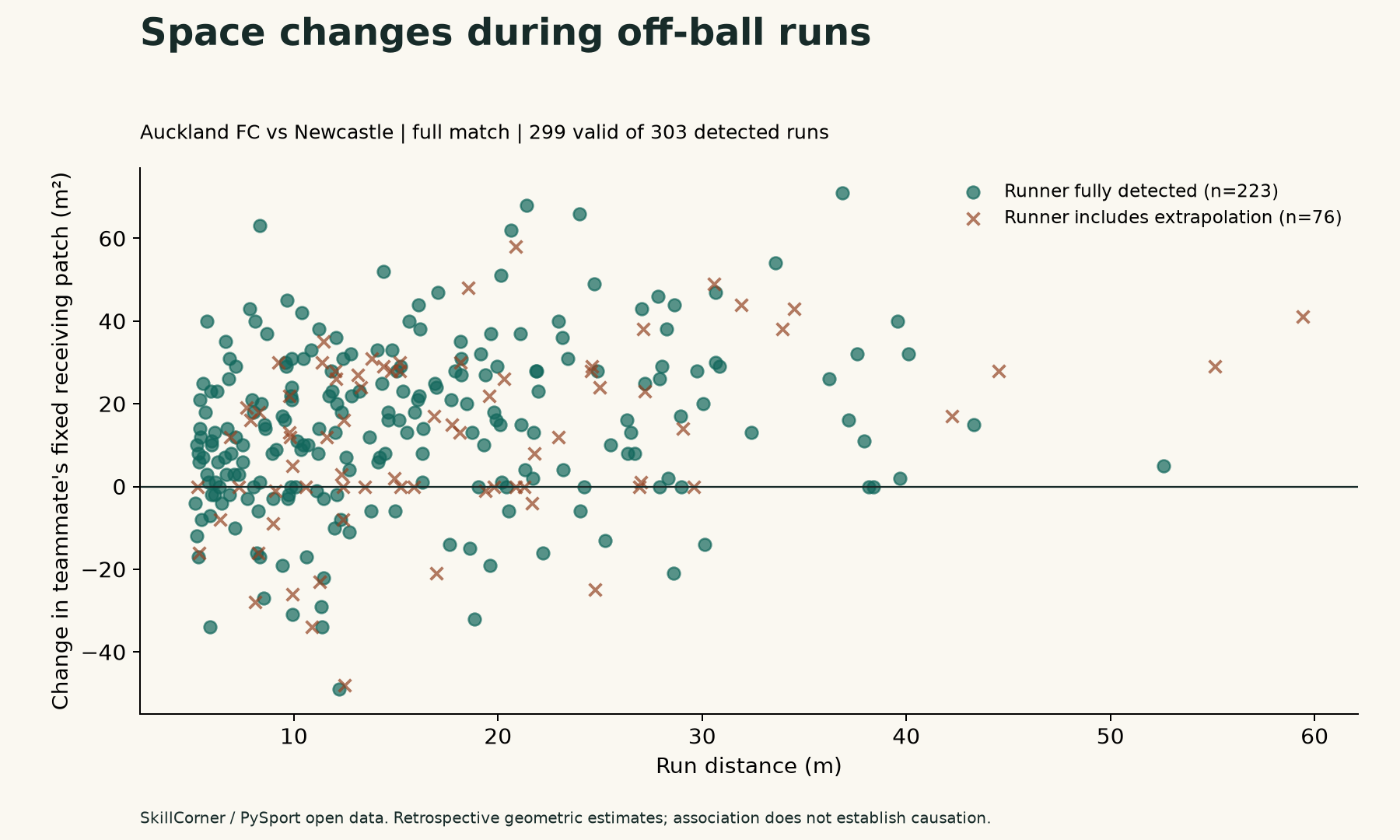
Space changes are geometric associations. Extrapolated positions and other players' movement can explain them. These measurements do not establish causal credit.
Profiles are calculated in Python from the same full match. The website filters those reviewed results; the Streamlit app supports additional recalculation.
No runs meet these filters. Reset the filters or select All estimates.
Star: runner · diamond: selected teammate · teal: attacking team · rust: opposition
Filled: detected · hollow: extrapolated · pale cells: already free · teal cells: newly free · rust cells: no longer free
Space change across the selected runs
Hover to inspect a run; select a point to load its replay. The run selector provides a keyboard alternative.
Inspect exact run records
| Player | Clock | Distance (m) | Patch change (m²) | Runner detected | Context detected |
|---|
What these measurements mean
A rule-based baseline
Each profile finds contiguous attacking movement at its speed threshold, lasting at least 1 s, travelling at least 5 m and progressing at least 3 m toward goal. Team possession comes from in-play phases; the runner stays at least 3 m from the tracked ball and outside their provider possession intervals.
Seven-frame smoothing reduces positional noise. Gaps, implausible raw jumps and source boundaries break trajectories. Missing carrier identities and extrapolated ball positions limit touch-free classification.
Space, defined precisely
A teammate is chosen from the starting state, before measuring change. Free patch area counts 1 m² cell centres within 6 m of that starting position, at least 3 m from every opponent. Context metrics require a complete, continuous opponent roster at both endpoints.
Behind-line runs cross the second-deepest outfield opponent. Wide runs finish in an outer channel while moving outward. Toward-space runs gain at least 2 m of nearest-opponent clearance. Categories can overlap.
Fully detected runners can still depend on extrapolated defenders. Strict coverage refers to the runner throughout the run, and contextual players and ball at both endpoints. It does not certify visibility between endpoints. No causal model or human-labelled accuracy study is included.
Historical snapshot of one match. No account, API key or live data feed is required.