Is possession actually dangerous?
Possession volume, territory and attacking value in women's football.
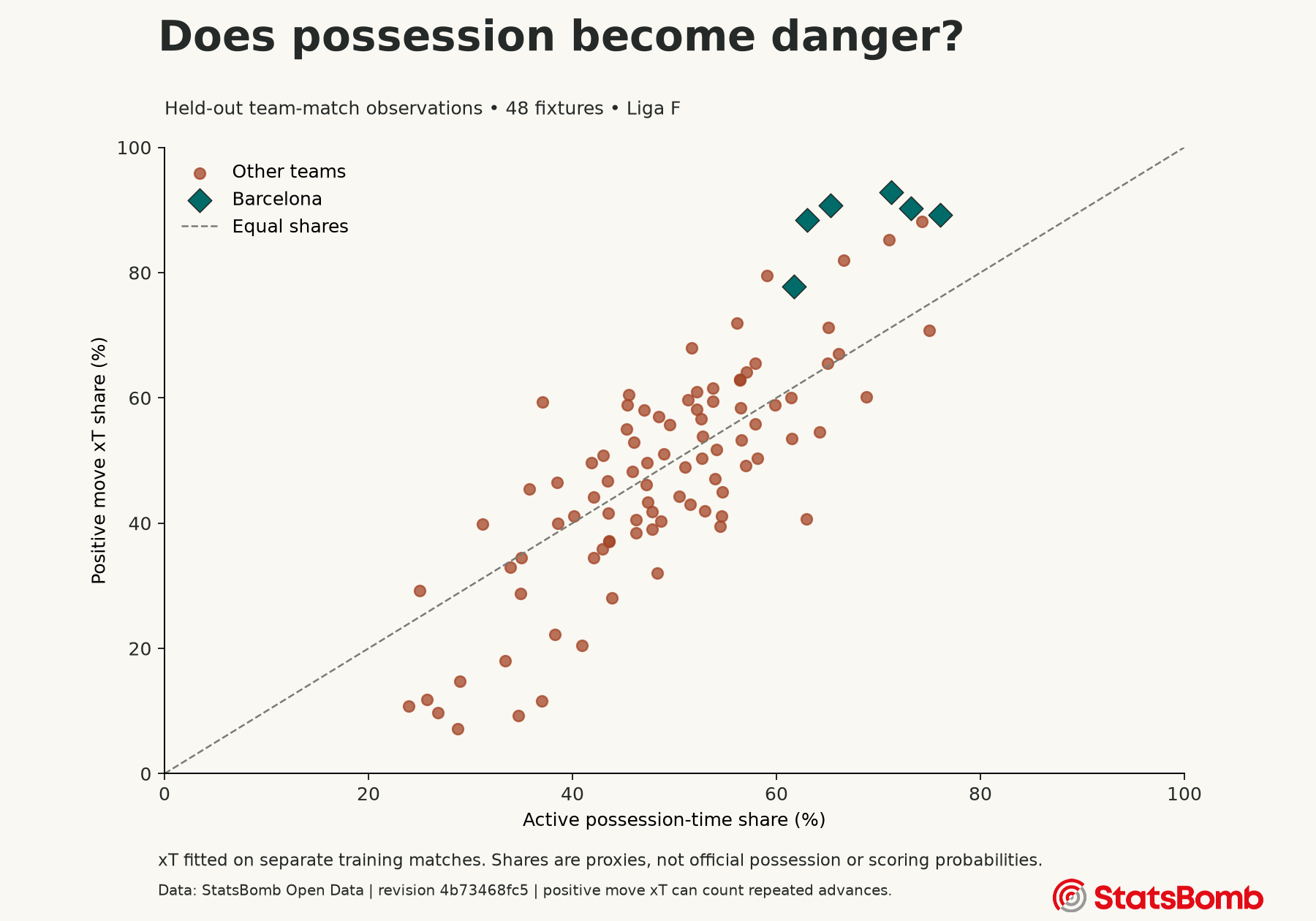
One point per team and match. The dashed line marks equal shares. Active time is a proxy, not official possession. Positive move xT can count repeated advances.
Threat per 100 possessions
Rates divide summed positive xT by summed analytical possessions. Teams have different opponent schedules; no strength adjustment is applied.
Same score state, different teams
Positive move xT per active possession minute, using the score before each action. Blank cells have no observed exposure. A goal shot belongs to the pre-goal state.
Inspect score-state exposures and rates
Follow one match
Elapsed playing clock concatenates periods, includes stoppage time and excludes halftime breaks. Cumulative xT is booked at sequence start.
Long possessions with little immediate threat
No shot and less than the selected xT ceiling. Low immediate threat does not mean tactically wasteful: lead protection and drawing opponents out cannot be established here.
Interpretable possession styles
Inspect a possession
The hosted view shows derived possession summaries. Run the Python/Streamlit workbench for event-by-event pass and carry maps. No event coordinates are distributed in this website.
What the metrics measure
- Analytical possession
- Provider possession ID, bounded by period and split when the other team passes, carries, shoots, dribbles, miscontrols, is dispossessed or shields. The provider's possession_team names the chain starter; defensive pressures and tackles do not switch the analytical owner.
- Elapsed and active duration
- Elapsed span includes gaps between owner actions. Active duration unions recorded owner on-ball action intervals and counts overlaps once. Both stop at the next analytical sequence. Neither is a continuous ball-in-play clock.
- Territory
- Field tilt is each team's share of completed passes starting in the final third (x ≥ 80 on a 120 × 80 pitch). Progression is last controlled x minus first x, in coordinate units, not metres.
- Expected threat
- The 12 × 8 grid solves V = r + TV using training matches only. Reward is empirical non-penalty goals per eligible action. Completed pass/carry transitions are divided by all eligible actions, including failures. Failed moves and explicit losses absorb at zero; every shot terminates the model path. Unseen cells remain zero.
- Move values
- Signed xT is V(end) − V(start) on successful passes/carries. Positive xT sums increases only and can count repeated advances. It is not a calibrated possession-goal probability. Penalties are excluded from xT but remain in observed shot/xG totals.
- Score state and validation
- The score is reconstructed before each indexed action, with own goals counted once and shootouts excluded. All final scores, passes, shots and shot xG reconcile with source data. Match-separated holdout prevents event-level leakage. Shot-choice Brier score checks one-step shot choice, not full xT calibration.
Location-only xT surface fitted on separate training matches. Finishing luck, sparse cells and ignored off-ball context limit interpretation.
Validation for this dataset
Reproduce and inspect
The full Liga F report and chart below refer to the 240-match release, regardless of current sample, league or team filters.
Data: StatsBomb Open Data. Methods: Karun Singh's xT explanation and socceraction reference. Provider data and branding retain their original research-use terms; the code licence does not relicense them.
Low-threat possession can be useful. This event-only analysis cannot establish intent, fatigue, off-ball control or causality. The Barcelona bootstrap comparison has six held-out fixtures and omits model-refit uncertainty.